
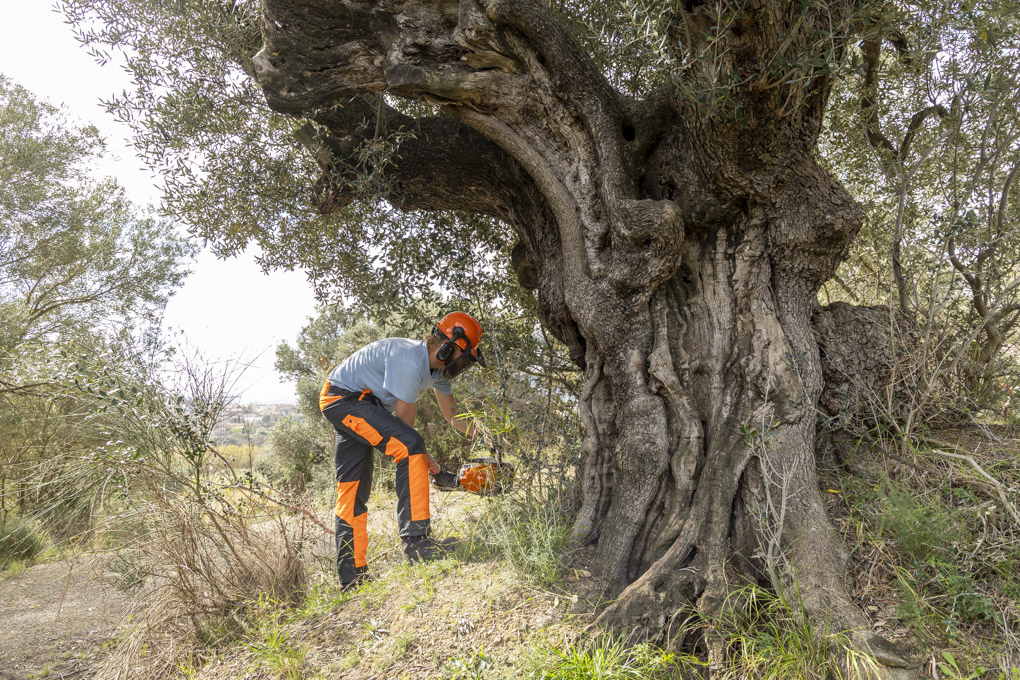
- Made from Arbequina, Becaruda and Vera del Vallès varieties, its added value lies in contributing to the prevention of a major forest fire in the largest peri-urban area of Catalonia
- The product is the result of an alliance between L’Olivera and the Fundació Catalunya La Pedrera to restore the agroforestry mosaic of Collserola
- Only 6.4% of Collserola is currently used for agriculture, compared to 21.5% in 1956
From March 25, L’Olivera and the Fundació Catalunya La Pedrera are launching the first edition of “L’Oli Nou de Barcelona”, an extra virgin olive oil produced within the framework of a project promoted by the Fundació Catalunya La Pedrera in the Collserola mountain range, in collaboration with the L’Olivera cooperative, the Collserola Natural Park, the Barcelona Provincial Council and the Forest Owners Association – Collserola Iniciatives. The aim of this initiative is to restore olive cultivation in this area, thus contributing to the reduction of large forest fires. In total, 156 hectares have been identified with potential to recover agricultural activity, approximately 2% of the natural park’s surface.
The oil has been produced using three Catalan olive varieties — Arbequina, Becaruda and Vera del Vallès — grown under traditional dry farming conditions. The harvest was carried out manually in 10–12 kg crates to preserve the quality of the fruit, followed by a low-temperature extraction process with gentle malaxation, two-phase centrifugal separation and filtration, resulting in a high-quality product.
The result is an aromatic oil that, on the palate, presents a slight bitterness and a spicy finish that develops progressively. It is ideal for raw consumption and also pairs well with hot dishes such as toasted bread, vegetables or steamed fish, enhancing their aroma.
The head of production at L’Olivera, Pau Moragas, highlights the following attributes: “This is an oil with multiple added values: territorial value, as it contributes to fire prevention and the recovery of the agricultural mosaic; social value, as it is produced within a social inclusion project; and cultural value, as it preserves agricultural tradition in an increasingly urbanised area.”
The product is now available in physical stores (Vallbona and Masia Can Calopa) and online at L’Olivera, at the Món Sant Benet shop, and in specialised stores such as Colmado Quílez (Rambla Catalunya, 65, Barcelona) and Vila Viniteca (shops on c/ Agullers and Illa Diagonal).
Collserola, an agricultural opportunity
In recent decades, the abandonment of agricultural and livestock activities has led to the replacement of the traditional agroforestry mosaic with a continuous low-quality forest, mainly composed of Aleppo pine, a highly flammable species. This change in the landscape has increased the risk of large forest fires, especially during periods of drought and westerly winds, putting both the natural environment and the scattered residential areas within the massif at risk.
In this context, the pilot project of the Fundació Catalunya La Pedrera has begun at the Oliveres Reverter estate, located in Sant Just Desvern, with the collaboration of the local council. The aim is to transform these former terraces into an agroforestry mosaic that combines oil production with strategic forest management for fire prevention. Currently, according to data from the Collserola Natural Park and the Alimentem Collserola association: only 6.4% of Collserola is used for agriculture, compared to 21.5% in 1956.
For Miquel Rafa, Director of Sustainability and Territory at the Fundació Catalunya La Pedrera, “Collserola offers a great opportunity: to transform a vulnerable landscape into an active, productive and resilient territory. This project is a clear commitment by the Foundation to connect agriculture, forest management and social impact.”
This first intervention foresees the recovery of these terraces with up to 240 olive trees of the Arbequina variety, planted between 2002 and 2006. Actions include intensive pruning, reducing tree density and clearing surrounding vegetation. From 2028 onwards, an estimated production of between 5,000 and 6,000 kg of olives, equivalent to around 1,500 litres of oil, is expected.
The collaboration between the Fundació Catalunya La Pedrera and L’Olivera exemplifies how sustainable forest management can become an effective tool for fire prevention and territorial development. The project represents a commitment to the environment, the territory and society, and opens the door to new opportunities for the Collserola mountain range.