

THE SOCIAL PROJECT
Since its beginnings, the social dimension has been at the heart of L’Olivera’s production project. This commitment is part of L’Olivera’s DNA: a holistic approach that brings together social inclusion and the production of high-quality products deeply rooted in their place of origin. All of this is driven by the belief that work is both a meaningful life experience and an emotional journey.
Alongside its production activities, L’Olivera works to foster the personal development and social inclusion of people with disabilities, providing care, therapeutic and educational support within an inclusive environment where people can live and work.
Learn moreLearn less
THE MODEL
In its social work, L’Olivera draws inspiration from the Person-Centred Planning (PCP) model, an approach that places respect for each person’s wishes, abilities and support needs at its core. This model empowers individuals to take an active role in their own lives, making their own choices, shaping their vision for the future and building their support networks. It promotes a holistic approach to care, emphasising employment as a fundamental pillar of personal independence, while also fostering autonomy in everyday life within the residential setting.
To make this possible, L’Olivera works with professionals specifically trained in this approach. An Individual Rehabilitation Plan (IRP) and a short-term Work Plan (WP) are developed for each person receiving support. Each individual is assigned a key worker who guides and supports them throughout the process. Every personalised pathway is managed individually, seeking the most appropriate actions and support measures to meet each person’s specific needs.


THE SOCIAL PROJECT IN VALLBONA
L’Olivera’s social programme in Vallbona de les Monges is organised into four distinct areas:
SPECIAL EMPLOYMENT CENTRE (CET)
This area encompasses L’Olivera’s production activities, including:
Agricultural work
Cultivation and maintenance of vineyards and olive groves, currently employing 3 people.
Wine and olive oil production
Activities related to wine and olive oil production, carried out at L’Olivera’s winery and olive oil mill, where 5 people are currently employed.
Hospitality services
Activities carried out at the Vallbona Bar (Vallbona Cafè), in which L’Olivera is a partner. This area currently employs 2 people.
OCCUPATIONAL THERAPY SERVICE (STO)
This service began operating on 1 June 2000, with the aim of providing comprehensive rehabilitative day care to promote the greatest possible social inclusion of people with disabilities who are unable to work full-time.
The service currently supports 8 people, helping them develop personal and social skills through activities such as aquatic activities, animal-assisted therapies and arts and crafts. It also offers work-related therapeutic activities, including maintaining the vegetable garden and surrounding areas, as well as manually labelling olive oil bottles.
OCCUPATIONAL INTEGRATION SERVICE (SOI)
The Occupational Integration Service offers an alternative pathway towards employment for people with intellectual disabilities who, despite having the necessary work-related and productive abilities, are not yet able to join Special Employment Centres due to a lack of vocational training or sufficient work capacity.
The service currently supports 2 people and acts as an intermediate step between the Occupational Therapy Service and the Special Employment Centre.
RESIDENTIAL HOME
L’Olivera’s social programme in Vallbona de les Monges includes a permanent residential home, open throughout the year, with capacity for 16 people.
THE SOCIAL PROJECT IN CAN CALOPA
L’Olivera’s social programme at the Can Calopa farmhouse in Barcelona is organised into four distinct areas:
SPECIAL EMPLOYMENT CENTRE (CET)
This area encompasses L’Olivera’s production activities, including:
Agricultural work and wine production
This includes the cultivation and maintenance of the vineyards and olive groves on the Can Calopa estate, as well as winemaking activities at the farmhouse winery, where 7 people are currently employed. This area also carries out agricultural work as part of external projects in which L’Olivera collaborates, such as managing the vineyard at the Parc Agrari de Sabadell.
Wine tourism activities
This area includes all activities related to the wine tourism experiences offered at the farmhouse and currently employs a total of 7 people.
RESIDENTIAL HOME
L’Olivera’s social programme at Can Calopa includes a permanent residential home, open throughout the year. The residence is located in a building adjacent to the Can Calopa farmhouse and has capacity for 12 people.
SUPPORT SERVICE FOR INDEPENDENT LIVING (PSAPLL)
This service includes three homes located in the municipality of Molins de Rei. It provides an intermediate step between residential care and independent living.
The 9 people living in these homes and receiving support through the service are independent in their basic daily activities but require guidance and assistance with certain instrumental and more complex aspects of everyday life.
The aim of the service is to promote personal independence and full inclusion in the local community.
WORK INTEGRATION SOCIAL ENTERPRISE (EI)
In January 2021, L’Olivera expanded its social activities with the creation of L’Olivera-Can Calopa Work Integration Social Enterprise, responsible for managing La Vinoteca de Can Calopa, the wine bar and tasting space located at the Can Calopa de Dalt farmhouse.
Its aim is to promote the social and professional integration of people experiencing social exclusion or at serious risk of exclusion.
To achieve this, the enterprise provides employees participating in its integration programme with personalised, supported pathways that combine paid employment, on-the-job training, the development of social and workplace skills, and tailored social support. These measures are designed to help individuals subsequently enter the mainstream labour market.


THE COOPERATIVE PROJECT
L’Olivera is a cooperative project shaped by many hands and many voices. From the very beginning, the cooperative model was chosen for its potential and because it best reflected the way of organising that the original L’Olivera community, founded in 1974 as a place to live and work together, had already adopted informally.
Learn moreLearn less

L’Olivera was formally established as a cooperative in 1976, under the name “Cooperativa Agropecuaria de Promoción de Deficientes La Olivera”. It was not until 1985 that its statutes were amended to establish it as a Worker Cooperative and Social Initiative Cooperative, reflecting its commitment to social inclusion.
Since then, L’Olivera has operated with a democratic structure and decision-making processes, in accordance with cooperative principles. Its aim is to provide employment opportunities for its worker-members through their direct personal contribution and the collective organisation of production. This collective structure brings together professionals from different disciplines, seeking to combine professionalism, flexibility and participation.
Today, L’Olivera is a dynamic and constantly evolving organisation, made up of:
Cooperative members: 33 worker-members and 31 supporting members.
Employees: 16 salaried employees who are not cooperative members.
For L’Olivera, the cooperative model represents a way of doing business in which economic and business objectives are integrated with social goals, enabling economic growth based on decent employment, social equity and equality.
This approach places us within the principles of the Social and Solidarity Economy, which offers an alternative to the capital-driven economy. It seeks to build relationships of production, distribution, consumption and financing based on justice, cooperation and mutual support, placing people at the heart of the economic system.
It also embraces a political dimension of social transformation towards a socioeconomic model based on non-capitalist forms of collective organisation, with a particular emphasis on democracy, self-management and collective entrepreneurship.
L’Olivera’s governing and organisational bodies are structured as follows:

Organisational Information
- Statutes
- Strategic Plan 2019–2024
- Annual Report 2020
- Annual Report 2021
- Annual Report 2022
- Annual Report 2023
- Annual Report 2024
- Annual Report 2025
Financial Information
Social Balance Sheet
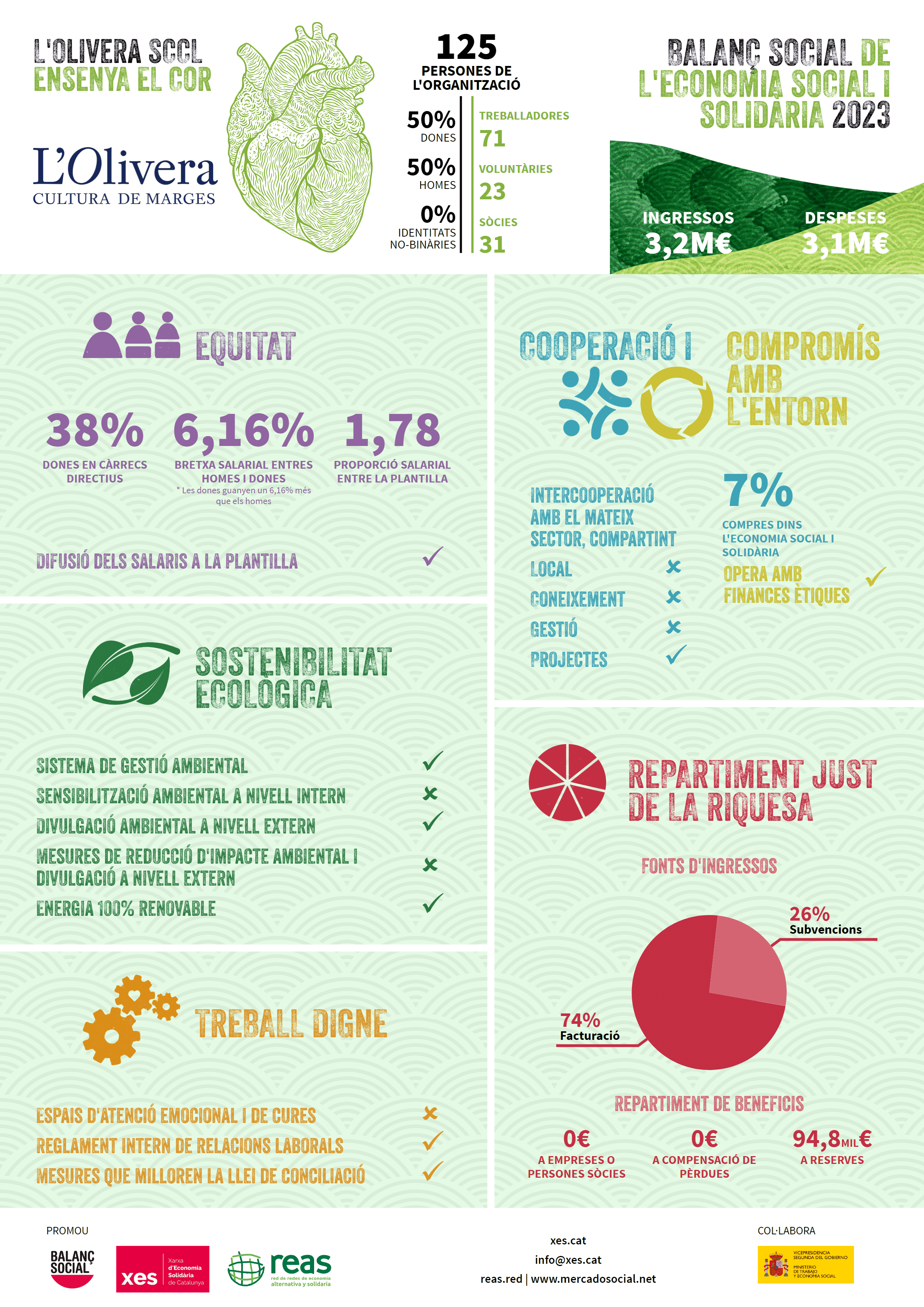

L'OLIVERA FUNDATION
In 2003, L’Olivera took a further step in its social mission by establishing the L’Olivera Foundation. The aim was to create an organisation that would ensure the long-term continuity of its social initiatives and promote new opportunities for the social and professional inclusion of people with disabilities or at risk of social exclusion, particularly in rural areas.
Learn moreLearn less
In addition, the Foundation manages 0.7% of the cooperative’s turnover, allocating it to social projects in developing countries with which L’Olivera has direct connections. Between 2008 and 2010, the Foundation devoted this contribution to the construction of a new building at El Mina School for people with sensory disabilities in Nouakchott (Mauritania).
Between 2010 and 2020, the Foundation also collaborated with Association Saint-Camille, an organisation promoting the social inclusion of people with mental health conditions in Benin, which also receives support in Catalonia from Associació Aïma.
Today, we continue to support international cooperation projects, including initiatives in Guatemala, in the community of San Pablo de Tacaná, where we work with the LUZ DE TODOS project. This programme promotes the development of electricity generation projects through the construction of small community hydroelectric power plants, managed by the communities themselves. Its aim is to provide a reliable, environmentally sustainable and affordable electricity supply to all residents of isolated communities in western Guatemala. The project is supported by Aiguasol, Tàndem Social, the Fets cooperative, Coop57 and Casal.
At the same time, we have collaborated on several vocational training workshop projects in the same region. In 2016, with the support of the Barcelona Bar Association, a legal office was established in the department of San Marcos, Guatemala, to defend the rights of rural farming communities.
Voluntary donations from individuals and organisations are channelled through L’Olivera Foundation.


Support L’Olivera Fundació
Your contribution will help support the life projects of people with intellectual disabilities and/or those at risk of social exclusion. Your support is invaluable in helping us continue working towards a more inclusive society.
Donate by Bank Transfer
To make a donation, please transfer your contribution to the following bank account: ES18 0182 0846 4102 0177 9570, indicating the full name of the account holder making the transfer.
Donate via Bizum
Open Bizum, select the option Donate to an NGO or Donate to a Charitable Cause, enter the code 08391, specify the amount you wish to donate and submit your donation.
In addition to their social impact, donations also offer tax benefits, as they may be deducted from personal income tax or corporate income tax.
Individuals: You can claim a tax deduction of 80% on the first €250 donated and 40% on any amount exceeding this threshold. Furthermore, if you have made donations to L’Olivera Fundació for three or more consecutive years, the deduction on the amount exceeding €250 increases to 45%.
Companies: A tax deduction of 40% applies to contributions or donations. Furthermore, if your company has made donations to L’Olivera Fundació for three or more consecutive years, the deduction increases to 50%.
*For more information, please refer to Articles 19 and 20 of Spanish Law 49/2002 on the Tax Regime for Non-Profit Organisations and Tax Incentives for Charitable Giving.
To obtain a donation certificate, which is required to claim a tax deduction for your donation, please complete the following form:

L’OLIVERA EDUCATION
At L’Olivera, we believe in education and training as valuable tools for developing our own project and sharing the values that underpin it. Over more than 40 years, we have built up a wealth of knowledge and expertise that we are committed to sharing. By promoting the exchange of knowledge, we aim to contribute to the development of the kind of society we strive to build every day.
Learn moreLearn less

THE CAN CALOPA LEARNING CENTRE
The Can Calopa Learning Centre is a space dedicated to raising awareness and sharing knowledge in two main areas in which L’Olivera has gained expertise over more than 40 years of experience. The first area, “Territory”, focuses on biodiversity, agroecology and the relationship between people and the land. The second area, “People”, centres on knowledge sharing and the Social and Solidarity Economy.
Activities in both areas are designed for primary, secondary and post-compulsory education students, with the aim of providing hands-on learning experiences in these two fields. The centre also offers educational and awareness-raising activities for families and the general public.
In this section, you will find information about the activities on offer, as well as their schedules and booking conditions.
VOLUNTEERING AND EDUCATIONAL PARTNERSHIPS
Since its beginnings, L’Olivera has been a welcoming and inclusive organisation, embracing people with diverse backgrounds, perspectives and needs. For this reason, it has offered a volunteering programme for many years through a range of partnerships.
On the one hand, L’Olivera has established educational partnerships with Catalan universities, such as Universitat Rovira i Virgili, Universitat de Lleida and Universitat Autònoma de Barcelona, as well as institutions from other parts of the world through international agreements with Universidad de Uruguay and Liceo Mmont in Chile. These partnerships also extend to non-university educational institutions, including Escola Mercè Domènech in Espiells – Sant Sadurní d’Anoia, Escola d’Enoturisme de Catalunya in Vilafranca del Penedès and ECA Borges Blanques, among others.
On the other hand, L’Olivera also develops partnerships focused on knowledge sharing and outreach, participating in various clusters, the Costers del Segre and Catalunya Designations of Origin, and networks dedicated to tourism, rural development and social support.
In addition, L’Olivera is a member of the international volunteering network WWOOF (World Wide Opportunities on Organic Farms), which offers volunteering opportunities on organic farms around the world.
INTERNAL TRAINING
L’Olivera devotes part of its efforts to the training and professional development of its employees in various areas. This includes specific skills related to each team involved in production or social services, as well as broader topics, such as cooperativism, that are relevant to the entire organisation.
For many years, L’Olivera has organised an annual training trip to introduce all its teams to other organisations and projects that share similar values or ways of working. The aim is to exchange knowledge and experiences, fostering both collective and individual growth.